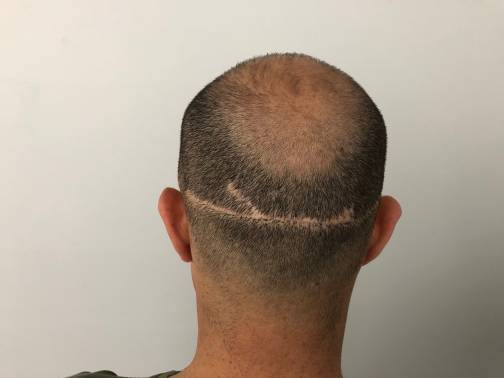
Concealing Hair Transplant Scar
Hair Transplant Scars There are two techniques of hair [...]
Fixing a Botched Hair Tattoo: From Tattoo Artist SMP to a Natural-Looking Hairline
This is a real SMP correction case study. When it comes to scalp micropigmentation (SMP), not all “hair tattoos” are created equal. We recently had a client come into The Look SMP after getting his hairline done years ago by a regular tattoo artist, and unfortunately, the results showed exactly why this distinction matters.
The Problem: A Tattoo Artist Is Not an SMP Artist
A lot of people don’t realise that scalp micropigmentation is a completely different discipline from traditional tattooing, even though both involve a needle and ink. Regular tattoo artists are trained to create bold, visible line work and shading on skin that’s meant to be seen up close. SMP artists are trained to do the opposite: replicate the exact size, depth, and density of an individual hair follicle, so the result looks like stubble or a closely shaved head rather than a tattoo.
Before correction
When our client came in, the issues were immediately clear. The dot size from his original work was significantly larger than a natural hair follicle, which is one of the most common giveaways of a non-specialist hair tattoo. On top of that, the ink used wasn’t designed for scalp micropigmentation. Most tattoo ink isn’t formulated to hold its tone under the skin the way SMP pigment is, which often leads to the dreaded “blue-ish” or “green-ish” fading over time, something we see constantly with botched SMP cases that started as standard tattoo ink jobs.
Step One: Assessing the SMP Correction — Can It Be Fixed, or Does It Need Laser Removal?
Before touching anything, we always start with an honest assessment. Not every case can be corrected directly. Sometimes the dot pattern is too large, too deep, or too saturated, and the only realistic path forward is laser tattoo removal first, followed by a fresh, properly executed SMP treatment afterwards.
In this case, after assessing the density, depth, and pigment behaviour, we determined the existing work could be corrected without removal. This isn’t always good news for every client who walks through our door, but when it’s possible, it saves significant time and means no removal sessions, no waiting months between treatments, and no extra discomfort.
Step Two: Redesigning the Hairline
Redesigned front hairline
The first part of the SMP correction focused on the hairline itself. The original line was too rigid and unnatural, a classic sign of tattoo-style work rather than SMP. We redesigned the frontal hairline to follow a more natural, irregular pattern, mimicking the way real hair grows in, with subtle recession points and varied density rather than a hard, uniform edge.
Step Three: Rebuilding Density
Filled-in area, same day
Once the hairline shape was corrected, we moved on to rebuilding density across the affected area. Using smaller, properly layered dots in the correct pigment, we filled in the existing work to create the appearance of natural follicle density rather than the patchy, oversized look from the original treatment.
What’s worth noting is that all three of these stages, the assessment, the hairline redesign, and the density correction, were completed in a single session. While not every correction case can be finished in one sitting (it depends heavily on how much rework is needed), this gives you an idea of how dramatically a proper SMP artist can transform a poorly executed hair tattoo.
Tattoo Artist vs SMP Artist: Why SMP Correction Matters
This case is a good reminder of a few key differences worth understanding before you book a hair tattoo treatment:
A normal tattoo is designed to be seen. SMP is designed to disappear into the scalp and mimic real hair follicles, which requires an entirely different technique, needle depth, and dot size.
Standard tattoo ink isn’t built for this. SMP pigments are specifically formulated to age in a consistent tone under the skin. Tattoo ink wasn’t designed with this in mind, and that’s exactly why it tends to discolour over time on the scalp.
Training matters more than the tool. A tattoo machine in untrained hands for SMP purposes is how most botched scalp micropigmentation cases happen. Specialist SMP artists train specifically in hairline design, density mapping, and pigment behaviour on the scalp, none of which is covered in standard tattoo training.
Correction isn’t always simple. As this case shows, sometimes a fix is possible directly. Other times, removal needs to come first. Either way, it takes an experienced eye to know the difference, and getting that assessment wrong can make things worse.
Thinking About Getting a Hair Tattoo? Choose an SMP Specialist
If you’re considering a hair tattoo for a receding hairline, thinning crown, or scarring, make sure you’re booking with a dedicated scalp micropigmentation artist, not a general tattoo studio. The technique, the ink, and the training are simply not the same, and as this case shows, the wrong choice can take years to correct properly.
At The Look SMP, we regularly work with clients looking for SMP correction after previous SMP or hair tattoo work that didn’t go to plan. If you’re unhappy with previous work or just exploring your options, get in touch for an honest assessment of what’s possible for your specific case.
